for early access to the latest igaming videos!


 and get the latest igaming news first!










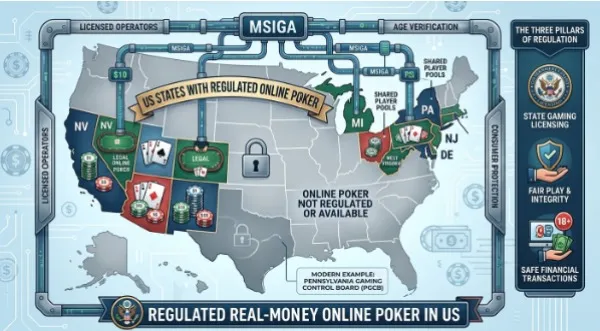
The USA is one of the largest online poker markets in the world, with a rich history that dates back to when it all started: the invention of the internet. As such, it is also one of the leading markets and one that has been home to some of the most frequented online poker tournaments.
However, the industry has had many bumps in the road to get to where it is today. As a matter of fact, US poker players who wished to try their luck online initially had to play across sites that were not regulated in the States. The US introduced the Unlawful Internet Gambling Enforcement Act in 2006, when online poker was booming in the country, leaving the industry in turmoil.
Thankfully, with time, individual states began creating their own regulated online poker markets. Today, six states are members of the Multi-State Internet Gaming Agreement (MSIGA): Nevada, New Jersey, Delaware, West Virginia, Michigan, and Pennsylvania. These states allow regulated operators to participate in interstate poker under the agreement, subject to each state’s laws and regulatory approvals.
US players from states participating in the MSIGA are in luck because the agreement makes interstate player pooling possible. That’s what we’ll focus on in this article, allowing anyone interested in participating to get the full picture.
Staying on track with developments in the industry is easy with sites like LegalUsPokerSites.com, and anyone who needs to gain a deeper understanding of the laws and rules can stay informed at all times.
States with Regulated Real-Money Online Poker
Online gambling regulation in the USA is quite well established, with precise and strict rules defined for all participants. Not all states can offer online gambling, and not all of the states that have regulated it offer all types of gambling.
When it comes to interstate online poker, six states are currently members of the MSIGA: Nevada, New Jersey, Delaware, Michigan, West Virginia, and Pennsylvania. Delaware and Nevada were the two states that came up with the idea of shared liquidity in 2014, and New Jersey later joined the agreement. Michigan joined in 2022, while West Virginia was added in 2023. Pennsylvania became the sixth member in 2025.
The MSIGA provides a framework for operators to share players across state lines, but participation is not automatic. Licensed operators and platform providers must receive the necessary approvals before offering multistate poker.
This means that players can participate in interstate poker games when they are physically located in a state where the relevant online poker offering is permitted and when the operator they are using has the required approvals. Operators use geolocation and other verification measures to establish that players are in an authorized jurisdiction.
Why Does Shared Liquidity Matter?
Shared liquidity, of course, matters a lot for each participating state, as it allows for larger player pools and better traffic. Not all states with regulated online poker have enough players on their own to keep offering around-the-clock poker online. Shared liquidity is immensely helpful when it comes to player pool size.
Larger player pools can help increase tournament prize pools and cash-game availability, allowing further growth of regulated online poker. The Pennsylvania Gaming Control Board specifically noted that joining the MSIGA would give Pennsylvania players access to larger prize pools without requiring an increase in buy-in amounts.
Cash-game traffic, on the other hand, depends heavily on whether the player pool is large or small. When there is low interest and too few players, operators can struggle to maintain a healthy selection of games and tournaments. This, of course, can give operators a bad name, and players can lose interest in the tournament and the site.
Shared liquidity, cash-game availability, and tournament prize pools are all connected. The more players are available within a shared network, the greater the potential for more active tables and larger tournament fields. They all lead to the ultimate goal: more players joining so that tournaments and cash games can be successful.
It is also important to remember that shared liquidity does not necessarily mean that all players are placed into one single pool. Different operators can receive approval to connect different combinations of states. For example, Michigan regulators have approved operators for different multistate combinations, including Michigan with Pennsylvania, Delaware, and West Virginia, as well as Michigan with Pennsylvania and New Jersey.
What Further Expansion Could Mean for the US Online Poker Market
Pennsylvania was the last to join the MSIGA. In 2025, Governor Shapiro signed the MSIGA, making the state the sixth member and the largest in the shared market. The Pennsylvania Gaming Control Board estimated that approximately 150,000 Pennsylvanians played online poker, and said that the state’s entry would expand the shared player pool by more than 50%.
The state’s entry represented a significant expansion of the interstate market. The addition of Pennsylvania also showed why large states can be particularly important to the future of shared online poker. A state with a substantial regulated player base can increase the potential size of shared pools, creating more opportunities for larger tournament fields and stronger cash-game traffic. Pennsylvania’s gaming regulator said that poker players supported joining the multistate market in order to enhance competition, provide access to larger prize pools, grow the poker industry, support smaller operators, and reduce unregulated play.
The fact that large states continue to consider or debate online gaming legislation shows that the US online poker market still has room for growth. This growth might be gradual, but it can be meaningful. If additional states legalize online poker and join the MSIGA, that could mean a much larger potential player pool, further expansion, and better competition.