for early access to the latest igaming videos!


 and get the latest igaming news first!










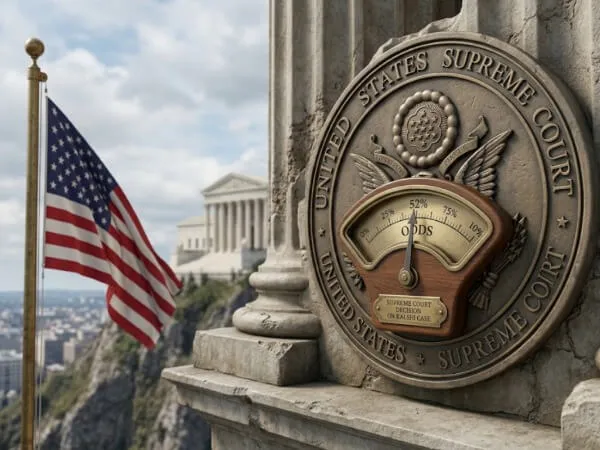
A legal fight over sports prediction markets has taken an unusual turn: the next big bet is on whether the U.S. Supreme Court will hear the dispute at all.
Polymarket’s international platform sharply increased its implied odds after the Ninth Circuit ruled against Kalshi on Friday. The probability of Supreme Court review rose from 29% to 52%, with nearly $1 million traded on the market.
The same market currently puts the chance of the court accepting the case before October 31 at just 6%.
The figures reflect a growing legal divide over who has authority to regulate sports-event contracts. The Ninth Circuit has now taken a position that conflicts with an earlier Third Circuit decision, creating the kind of split that can attract Supreme Court attention.
Ninth Circuit Rejects Kalshi’s Argument
The case began in Nevada, where state authorities moved to block Kalshi’s sports contracts. A federal judge issued an injunction preventing the company from operating those markets in the state, prompting Kalshi to appeal.
The Ninth Circuit panel unanimously upheld the core position against the prediction-market operator.
Kalshi has argued that the Commodity Exchange Act gives the federal government, through the Commodity Futures Trading Commission, authority over its contracts and prevents states from applying their gambling laws to them.
The Ninth Circuit disagreed. Its ruling found that the federal law likely does not prevent Nevada from enforcing its gaming regulations against Kalshi’s sports contracts.
That puts the decision directly at odds with the Third Circuit, where judges previously ruled 2-1 that Kalshi was likely to succeed in arguing that the federal law takes precedence over state gambling restrictions.
The disagreement is significant because it goes beyond one company or one state. The CFTC has increasingly taken the position that prediction markets fall under its federal jurisdiction, while states, tribal interests and much of the traditional sports-betting industry have pushed back.
The agency has also backed regulatory changes that would make sports-event contracts more clearly permissible.
The Ninth Circuit ruling leaves some room for debate over the underlying federal law. Judge Kenneth Kiyul Lee pointed to uncertainty in the Commodity Exchange Act’s special provisions concerning gaming contracts. His reasoning suggests that the law may give the CFTC discretion over certain gaming-related contracts rather than imposing an outright prohibition.
That distinction could matter if the dispute reaches Washington.
Supreme Court Review Is Still Far From Certain
There are now two competing appellate rulings, but that does not guarantee a Supreme Court hearing.
New Jersey, which has challenged the Third Circuit decision, has until September 3 to ask the Supreme Court to review that case. Kalshi has indicated that it will also pursue further review of the Ninth Circuit ruling.
The cases have so far centered on preliminary decisions rather than a fully developed final judgment. That could give the Supreme Court a reason to wait rather than step in immediately.
Legal opinion is divided.
Gaming attorney Daniel Wallach has previously put the likelihood of an eventual ruling against prediction markets at 70% to 80%. He has also argued that the Ninth Circuit’s treatment of Kalshi’s contracts as sports gambling could create serious problems for future CFTC efforts to establish a federal framework for sports-event contracts.
Other legal observers are less confident. Law professor Melinda Roth has described the Supreme Court outcome as closer to a coin flip and pointed to the possibility that the court’s composition could change before the case is ultimately heard.
There is also the question of timing. Even if the justices agree to take the dispute, a hearing could be more than a year away.
The Supreme Court’s 2018 decision striking down the federal sports-betting ban gave states broad authority to regulate sports wagering. But that ruling does not settle the separate question of whether contracts traded through federally regulated prediction markets should be treated as financial instruments or gambling products.
For now, Kalshi is facing a patchwork of court decisions and state restrictions. Its markets have already been blocked in Michigan, Washington and Nevada following a series of setbacks.
Polymarket’s market on Supreme Court review adds another layer to the dispute. Traders are now putting a price on the court’s next move before the justices have even decided whether they want the case.
There is not yet a comparable market on the eventual winner.
That one may have to wait.
Source: casinobeats.com