
 for early access to the latest igaming videos!


 and get the latest igaming news first!













Ohio is quickly establishing itself as a powerhouse in the Midwestern gambling market. With the historic introduction of legal sports gambling taking place in January of 2023, the “Buckeye State” has exceeded every projection of user activity and has been consistently placed among the five largest betting markets in the United States. Although very competitive and established as a mature market for digital sports gambling, Ohio is now at an important crossroads concerning the potential for expanding to full-scale iGaming (online casinos and poker) through new legislative initiatives.
The state is still on the “watch list” as of the first quarter of 2026. Two competing bills were introduced in 2025—HB 298 and SB 197. Both tracks opened the door for the legalization of online gaming, but have not passed the significant hurdle of losing the executive veto (likely due to a configuration change). This report focuses on reviewing how successful current verticals have performed and how regulations may be changing, as well as recognizing the huge untapped market potential within the hanging digital gaming ecosystem in Ohio.
Market Overview
Ohio has quickly established itself as one of the country’s leading jurisdictions for gaming. Following the legalization of sports wagering in January of this year, Ohio has moved aggressively into mobile platforms, developing a robust gaming ecosystem that includes both traditional, land-based gaming and a highly active digital sports betting market. Although the state does not currently permit iGaming (online casinos or poker), the gaming environment in Ohio demonstrates a strong consumer demand for digital entertainment.
Table 1: Ohio Annual Gaming Revenue Performance (2023–2025)
| Year | Total Handle (Wagering) | Gross Revenue (GGR) | Avg. Hold % | Tax Collected (State) |
|---|---|---|---|---|
| 2023 | $7.67 Billion | $936.4 Million | 12.2% | $134.5 Million |
| 2024 | $8.89 Billion | $905.8 Million | 10.2% | $181.1 Million* |
| 2025 | $10.23 Billion | $1,052.2 Million | 10.3% |
*Note: 2024 tax revenue reflects the first full year of the increased 20% tax rate (doubled from 10% in July 2023).

Market Size and Growth Trajectory
The Ohio market has moved from a “launch phase” into a “maturity phase,” characterized by sustainable, high-volume activity.
- Sports Betting: The sector has exceeded expectations, with an annual handle surpassing $10.3 billion in 2025. Gross Gaming Revenue (GGR) for sportsbooks topped $1 billion for the first time, signaling a resilient consumer base.
- Retail Gaming: Ohio’s 11 physical facilities (4 casinos and 7 racinos) remain foundational, generating approximately $2.3 billion in annual revenue. Slot machine play accounts for over 70% of this retail revenue, highlighting a stable preference for mechanical and digital-reel gaming among onsite patrons.

Popular Game Types
The state’s gaming portfolio is currently bifurcated between regulated retail and digital offerings:
- Sports Betting: The undisputed leader in digital engagement. High-frequency options, specifically parlay betting and micro-betting, represent the fastest-growing sub-sectors.
- Retail Slots/VLTs: The “bread and butter” for land-based operators.
- The “iGaming Proxy”: In the absence of state-sanctioned real-money iGaming, social and sweepstakes casinos have captured a significant segment of the digital-native audience, serving as a placeholder for casino-style entertainment.
Player Demographics
Concentrated with respect to player profile, Ohio aligns with national trends in technology adoption and leisure spending:
- Core Demographic: Primarily men, age 25 – 45
- Behavioral Preferences: High engagement (usage) patterns with mobile applications; tech-savvy consumers; strong interest in “in-game” betting opportunities; preference for instant withdrawal payment options.
- Engagement Patterns: Total handle is driven by high roller players with a much broader mix of casual and smaller-stake parlay players providing the continued daily volume needed for market profitability.

Regulatory Landscape
The State of Ohio has a flexible regulatory structure that is constantly being revised to ensure that there is ample taxation revenue while still protecting players. There are various entry barriers into the market, as well as strict compliance requirements, as governed by two primary controlling agencies within the State of Ohio.
Regulatory Authorities and Oversight
- Ohio Casino Control Commission (OCCC): Virtually all forms of casino gaming and/or sports betting under the authority of this agency. This includes the vetting of operators, ensuring that fair and honest games are played, and the licensing of all “Proprietors” and “Sports Gaming Suppliers.”
- The Ohio Lottery Commission: Responsible for the Ohio Lottery and regulates the operation of Type C sports gaming (bar/restaurant kiosks) and Video Lottery Terminals (VLT’s) at Ohio’s racinos.
Licensing Requirements
The licensing system has three different categories. All applicants in the 2026 licensing period need to meet high transparency standards. The first category is for sports gaming proprietors, broken down into:
- Type A – Online/mobile
- Type B – Retail sportsbooks
- Type C – Lottery-style kiosks
The second category is for iGaming, which has been proposed under House Bill 298/Senate Bill 197 to require a $50 million licensing fee from in-state casino operators wishing to offer online gaming. These proposals also state that out-of-state casino operators face fees in excess of $100 million for the right to operate online gaming in Nevada under restrictive Senate proposals.
The third category is for key employee licenses; all executive-level and senior management gaming employees are required to submit to a suitability investigation every three (3) years to maintain their respective licenses.
Taxation and Compliance Details
Compared to its original launch, Ohio has now changed to being a “high-tax” jurisdiction. For example:
- Current sports betting taxes have essentially doubled to 20% of net revenue effective January 1, 2026.
- The withholding rates for sports gaming proprietors will be 2.75% of Ohio income tax withheld from winnings starting January 1, 2026.
- Beginning with the 2026 tax year, the IRS has also established a single $2,000 reporting threshold for sports wagering winnings (if subject to the 300-to-1 odds rule), resulting in the multiple reporting thresholds no longer existing to operate on a digital basis.
- Currently, 98% of all revenues generated from Gaming Taxes in Ohio are allocated to the Sports Gaming Profits Education Fund, while only 2 % of such revenue is allocated for problem gambling services.
Upcoming Legislative Changes
The 2026 legislative calendar is dominated by the push for House Bill 298. Key features of this pending legislation include:
- Legalization Goal: Establishment of an official launch date for real-money iGaming no later than March 31, 2026.
- Ban on Sweepstakes: Included in the bill is a provision banning online sweepstakes platforms as unregulated competition to licensed iGaming.
- Tax Increase: Proposed gaming tax rates differ dramatically – from a low of 28% in the House to a high of 40% in the Senate. The differing tax rate proposals illustrate how aggressively the state government intends to deal with digital gaming.
Table 2: Proposed iGaming Legislative Framework (HB 298 vs. SB 197)
| Feature | House Bill 298 (Stewart/John) | Senate Bill 197 (Manning) |
|---|---|---|
| Proposed Launch | By March 31, 2026 | Late 2026/Early 2027 |
| Initial License Fee | $50 Million (In-state only) | $50M (Local) / $100M (Out-of-state) |
| Proposed Tax Rate | 28% | 36% to 40% |
| Revenue Forecast | $400M – $800M annually | $600M – $1B+ annually |
| Key Restriction | Bans online sweepstakes | Allows iLottery & Horse Racing |
Competitive Landscape
The gambling sector in Ohio consists of 15 licensed digital operators competing vigorously with each other for market share; with 11 land-based venues also partaking in the competition for “handling” (the total amount wagered during a gaming day). Following the mid-2025 transition to a period of aggressive marketing towards acquiring new clientele, the industry now finds itself undergoing a process of consolidating company brands as well as tightening the grip on its overall operational efficiency.
Key Market Players
The landscape is segmented between global digital giants and established local land-based incumbents:
- National Leaders: FanDuel and DraftKings remain the undisputed “Big Two,” consistently capturing the lion’s share of both wagering volume and revenue.
- International Powerhouses: bet365 has aggressively expanded its Ohio footprint, successfully positioning itself as the primary challenger to the domestic leaders through extensive global markets and high-value promotional spends.
- Local & Regional Stalwarts: MGM Northfield Park (BetMGM) and PENN Interactive (ESPN BET/theScore Bet) leverage their physical casino presence to drive omnichannel loyalty. JACK Entertainment (betJACK) serves as the local “hometown” hero, focusing specifically on Ohio-centric user experiences.
Market Share Distribution (2025–2026)
While over a dozen apps are available, the market is highly top-heavy. Data from late 2025 and January 2026 indicate a clear hierarchy:
- Tier 1 (Dominant): FanDuel and DraftKings control approximately 65–70% of the total online handle.
- Tier 2 (The Challengers): bet365, BetMGM, and Fanatics Sportsbook fight for the next 20–25% of the market.
- Tier 3 (Niche/Local): Operators like Caesars, Prime Sports, and betJACK capture the remaining 5–10%, often focusing on high-limit bettors or specific local team loyalty.
Table 3: Digital Market Share by Operator (January 2026)
| Rank | Operator | Monthly Handle (Est.) | Market Share (%) | Key Ohio Partner |
|---|---|---|---|---|
| 1 | FanDuel | $295.3 Million | 32.2% | Belterra Park |
| 2 | DraftKings | $300.9 Million | 32.8% | Hollywood Toledo |
| 3 | bet365 | $78.0 Million | 8.5% | Cleveland Guardians |
| 4 | BetMGM | $68.9 Million | 7.5% | MGM Northfield Park |
| 5 | Fanatics | $52.8 Million | 5.8% | Columbus Blue Jackets |
| 6 | Others | $121.7 Million | 13.2% | Various |

Partnerships and Strategic Alliances
Success in Ohio is increasingly tied to “hyper-local” visibility. Operators have secured exclusive rights with professional sports franchises to integrate betting into the fan experience:
- Cleveland Guardians & bet365: A multi-year deal that includes prominent stadium branding and digital integrations.
- Cleveland Cavaliers & Caesars: Featuring a state-of-the-art retail sportsbook located directly inside Rocket Mortgage FieldHouse.
- Cincinnati Bengals & FanDuel: A partnership focused on “no-sweat” tokens and Cincinnati-centric odds boosts.
- Columbus Blue Jackets & Fanatics: Leveraging Fanatics’ massive retail database to convert apparel buyers into sports bettors.
Consumer Trends
As the Ohio consumer profile evolves, it reflects an increasing integration of gaming into everyday life. Players from the “Buckeye State” no longer refer to themselves as just “gamblers;” they now see themselves as “entertainment consumers,” and their expectation is that there will be fluid motion from social media applications to live sporting events to wagering.
Player Behavior and Preferences
Ohioans exhibit a sophisticated, high-frequency betting style that favors complex outcomes over simple win/loss wagers.
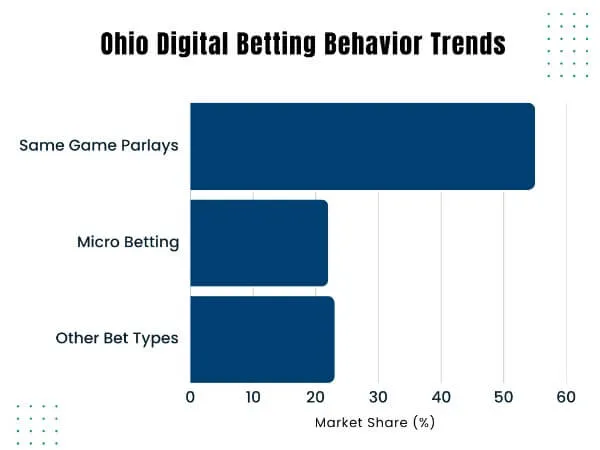
- The “Parlay Pivot”: There has been a massive shift toward Same Game Parlays (SGPs), which now account for over 55% of the total digital handle. Players prefer the “low-risk, high-reward” narrative of multi-leg bets.
- Micro-Betting Maturity: Driven by 5G infrastructure, “micro-betting”—wagering on the outcome of a single pitch, a specific play-drive, or the next basket—has grown to 22% of all in-play wagers.
- Gamification and Social Betting: Younger demographics (Ages 21–30) are increasingly using “bet-sharing” features, where they can post their slips directly to platforms like X or Discord to follow “tailing” trends within their social circles.
Table 4: Ohio Player Demographics & Risk Profile (2026)
| Demographic Category | Metric / Finding | Trend Direction |
|---|---|---|
| Primary Age Group | 25–44 years old (53% of market) | Increasing (Younger cohort) |
| Gender Distribution | 69% Male / 31% Female | Female participation rising (+10%) |
| Mobile Usage | 98.1% of all sports wagers | Near-total saturation |
| Responsible Gaming | 47% of users utilize limit-setting tools | Increasing (Regulatory focus) |
| At-Risk Population | ~250,000 residents (est. gambling disorder) | Triple 2017 levels |
Payment Methods and Technological Trends
The main factors that drive platform loyalty by 2026 will be efficiency and trust.
- Instant Withdrawals: Real-time payments and instant withdrawals through debit card push capability have become the norm across the entire industry. The average Ohio user has a 30% higher chance of leaving the platform if they do not receive their withdrawal within 24 hours.
- Biometric Security: As high as 85% of mobile logins in Ohio now utilize either FaceID or fingerprint authentication to mitigate friction and to provide a “one-tap” betting experience.
- Digital Wallets: The use of digital wallets, such as Apple Pay and Google Pay, has surpassed that of traditional credit card entry due to the user preference for having an “invisible” payment infrastructure that does not require any manual data entry.
Social and Cultural Influences
Gambling has become part of the social fabric in Ohio by enhancing the sense of belonging and encouraging social responsibility towards gambling.
- Socialization through Sports: Wagering on sporting events has been changing over the last 10 years. In addition to creating bonding opportunities with friends/families, wagering on sports has become a regular topic of conversation in bars and other social environments.
- By increasing the availability of RG “tools” used by gamblers in Ohio, such as deposit limits and “reality check” pop-ups, players have developed a greater awareness of being responsible gamblers. As of January 2026, approximately 47% of Ohio’s active gamblers have used at least one RG tool, and there is a strong cultural shift against excessive promotion of gambling, resulting in a “safety-first” mentality about betting on sports.
- Preferred “Homespun” Operators: A strong cultural connection to local operators exists in Ohio, with the majority (over 80%) of Ohio’s active sports betters preferring to use operators associated with 1 of the state’s 3 major professional sports teams (Cleveland Browns, Cincinnati Bengals, Cleveland Cavaliers) over an out-of-state operator without an association with an Ohio franchise team.
Opportunities & Challenges
Opportunities
- iGaming: If legalized, there is an expectation that online casinos alone will bring between 400 million dollars and 800 million dollars of annual tax revenues. This is a huge opportunity for existing sports betting operators to sell to their customers higher-margin casino products.
- Specific Markets: As the two larger operators (Fan Duel and Draft King) dominate the mainstream of the business, there is still an opportunity for smaller operators such as Prime Sports or Betr to go after higher volume, better demographics, or a younger, micro betting demographic.
Challenges
- Legislation: Due to political factors in 2026, there will be no major updates until after the elections for governor in November.
- Competition Doubts: Operators at brick-and-mortar casinos are split on whether legal iGaming will be beneficial by stealing their customers or by evolving their business model.
- Cost of Operations: The 20% tax on sports betting will increase the need for operators to operate efficiently and with lower marketing expenses; and iGaming taxes may increase one day soon, therefore, increasing costs even more.
Conclusion & Recommendations
The Ohio state market for gambling is strong and has produced a multi-billion-dollar gambling industry. Although there are no online casinos right now (due to temporary limitations), entering into the iGaming Industry should be possible once the legislative gridlock is removed, especially given how mature Ohio’s sports betting market is.
Strategic Recommendations
- Operators should concentrate on social casino and free-to-play gaming products in 2026. This allows operators to build databases and become familiar with their brand before the anticipated iGaming launch during 2027-2028.
- Investors should follow the political climate closely after the November 2026 elections, as a change in executive leadership can signal progress to iGaming legalization.
- Market universities will have to shift focus from a more aggressive / “bonus-laden” acquisition model towards a more “loyalty-based” retention model because, with margins being reduced due to a 20% revenue tax, equilibrium must be established between the cost of acquiring a customer (CAC) and the lifetime value of that customer (LTV).
Future Outlook: Ohio has all of the components to continue being one of the top 5 states for gambling activity in the U.S., and when Ohio becomes a full-stack iGaming marketplace, it’s not a matter of if, it’s simply a matter of time.
Data and Sources:
- Ohio Casino Control Commission (OCCC): Official monthly and annual revenue reports for all casino and sports gaming operations in the state.
- Ohio Legislature – House Bill 298 Analysis: Detailed fiscal notes and legislative text regarding the 2026 iGaming legalization and proposed 28% tax structure.
- Ohio Lottery Commission: Annual comprehensive financial reports detailing lottery sales, VLT performance at racinos, and education fund transfers.
- Commercial Gaming Revenue Tracker: National and state-specific data used to benchmark Ohio’s market share against other leading U.S. jurisdictions.
- Eilers & Krejcik Gaming (EKG): Market analysis and projections for U.S. iGaming and prediction markets used for 2026-2027 outlooks.
- Gaming Intelligence: Financial news and data summaries for Ohio sports betting totals and year-over-year growth metrics.
- Status Reports: Real-time tracking of Senate Bill 197 and House Bill 298 progress within the 136th General Assembly.


