for early access to the latest igaming videos!


 and get the latest igaming news first!










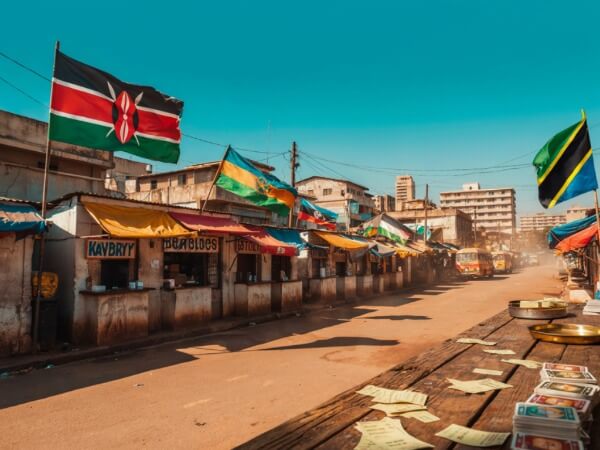
The biggest misconception about East Africa’s betting industry is that it is built entirely around smartphones.
The reality is more complicated.
A bettor may open an app, use mobile money and place a wager within seconds. But behind that digital transaction is often a physical network of kiosks, shops and agents where cash enters and exits the system.
That retail layer is becoming increasingly important as operators look beyond Kenya and assess opportunities in markets such as Uganda, Tanzania and Zambia.
The future of the region’s iGaming market may not be decided only by who has the best app. It may depend on who controls the strongest offline distribution network.
Mobile Money Still Depends on Physical Cash Points
Uganda’s gaming regulator has highlighted the dominance of mobile payments in the country, with almost all gaming activity flowing through mobile money channels.
That figure is accurate, but it hides a key part of the process.
For many customers, mobile money does not begin digitally. It starts with cash.
A player may visit a kiosk to load funds into a wallet, pass a betting shop while buying everyday goods, or return to a local agent to collect winnings. The phone provides access, but the physical network keeps the system moving.
Kenya’s mobile money market shows the scale of this connection.
Safaricom’s financial results for the year ending March 2026 showed that M-Pesa processed KSh41.68 trillion in transactions, a 25% increase compared with the previous year. At the same time, Kenya’s central bank recorded 602,470 registered mobile money agents by June 2026, rising sharply from 501,399 only three months earlier.
Those agents represent thousands of physical locations embedded into everyday retail.
For betting operators, they are not simply payment points. They are part of the customer acquisition system.
Tax Changes Put More Focus on the Transaction Network
Kenya’s recent tax reforms show that authorities also see value in tracking the movement of money rather than only the final wager.
The Finance Act 2025 moved excise duty from the betting event itself to deposits. The headline rate was reduced from 15% to 5%, while the taxable base was expanded.
Operators continue to pay a 15% tax on gross gaming revenue, while withdrawals remain subject to withholding tax.
The Parliamentary Budget Office expects the revised approach to significantly increase collections, projecting growth from KSh5.4 billion to KSh11.4 billion.
The shift reflects a wider change in how regulators view the market. The mobile wallet, agent network and payment infrastructure provide a clearer picture of activity than the betting application alone.
Mapping Where the Market Actually Happens
Population data has traditionally guided expansion decisions. But retail intelligence companies are challenging that approach.
Trendtype’s Market Navigator tracks thousands of retail locations across East Africa and combines commercial activity with income indicators to show where consumer spending actually takes place.
The difference matters.
A large population does not automatically create a strong betting market. Operators need areas with customer movement, accessible payment points and active retail ecosystems.
In Nairobi, the data shows a divide between wealth and commercial activity. Higher-income areas such as Westlands and northern suburbs stand out on income maps, while some of the strongest retail concentrations appear closer to central and eastern parts of the city, where shop density is higher.
The lesson is simple: money does not always move where population statistics suggest.
Retail activity often follows transport routes, commercial corridors and daily movement patterns.
The same trend appears in other major cities.
In Kampala, retail concentration is strongest inside the urban area formed by Nansana, Kira and Bweyogerere, before declining further outside the city. In Dar es Salaam, organised retail is concentrated around areas such as the Kariakoo and Kinondoni corridors.
For operators planning expansion, those patterns can be more valuable than broad demographic estimates.
The Missing Data Behind Expansion Decisions
Traditional licensing records and telecom reports reveal how large a market is. They do not necessarily show where customers actually interact with the industry.
That gap has become more important as operators compete for growth across Africa.
Retail mapping uses a different approach, combining store-level information, census data and satellite-based estimates to identify commercial hotspots.
The reason is that economic conditions in many African markets can change quickly. Areas considered middle-class today may not remain the strongest consumer zones tomorrow.
For companies entering new markets, knowing where retail activity is concentrated can influence everything from agent recruitment to marketing investment.
The Next Battle Will Be Distribution
East Africa’s betting sector is becoming more regulated. Kenya, Uganda and Tanzania are tightening oversight while adjusting tax systems around transactions that are easier to monitor.
Uganda has focused enforcement efforts on following financial flows through banks, telecom providers and payment companies.
That trend could benefit operators with transparent, organised networks. It could also reduce the advantage previously held by informal channels that were harder to track.
SportPesa executives have previously stressed that African markets cannot be approached with a single strategy. Each country requires a different understanding of customers, habits and local conditions.
Retail intelligence adds another layer to that understanding.
Kenya’s licensed operators are competing for access to the same ecosystem of trusted cash points, agents and customer relationships. Building that network may prove as important as developing the betting platform itself.
The region’s iGaming story is often described as a mobile revolution.
But the infrastructure underneath it remains physical.
The next stage of East Africa’s betting market will likely be shaped not only by the apps customers use, but by the shops, kiosks and agents that connect those customers to the digital economy.
Source: igamingfuture.com